
Developers of Distributed Energy Resource (DER) projects, spanning solar, wind, energy from waste, and storage, must balance site selection with early insight into network capacity access. Grid screening typically focuses on Grid Supply Points (GSPs), Bulk Supply Points (BSPs), and Primary substations for larger schemes. But as projects scale down, visibility becomes a challenge: below Primary Substation level, data on network capacity is limited, with public sources like DNO Long Term Development Statements offering little to no detail on 11kV, 6.6kV, or LV networks.
Understanding Network Constraints
To guide decisions, DNO heat maps provide a high-level view of available capacity using red, amber and green classifications. While useful for initial direction by highlighting areas of apparent headroom or constraint, these maps are based on worst-case scenario assumptions, such as maximum generation coinciding with minimum demand (and vice versa), rather than reflecting continuous, real-time network conditions.
As a result, these heatmaps only present a static snapshot of capacity, built on aggregated data. This can oversimplify reality, masking localised constraints or overlooking latent capacity opportunities. For developers, navigating this uncertainty has become a critical part of the capacity screening challenge.
Smarter Grid Solutions specialises in time-step network analysis and hence our capacity screening services crucially model the headroom at GSP, BSP and Primary substations accounting for varying demand and generation interactions at half hourly time steps across an average year. This provides a clearer picture of potential capacity availability for network zones that would be considered Amber and Red in a DNO heatmap, considering the potential for curtailable or restricted-access style connections. Our approach quantifies the opportunity for network access restrictions equate in terms of available MWh of export/import capability for a specified DER technology type.
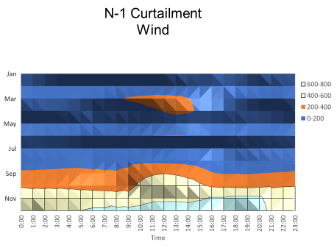
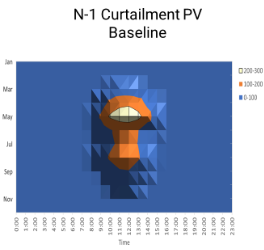
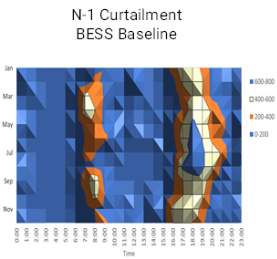
(Heat Diagrams show annual half hourly curtailment assessment results across each month for differing DER technologies, also showing where there is no curtailment)
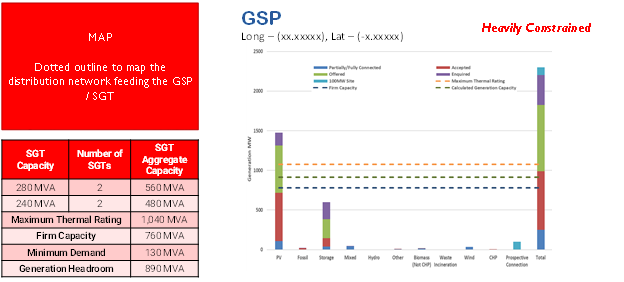
(Diagram illustrates capacity assessment using public domain data for a GSP which appears to be heavily constrained, however, an annual half hourly curtailment assessment provides a clearer picture of network access availability)
What Really Matters in Capacity Assessment?
Connection Queue Dynamics
A key consideration for capacity screening is the queue of Distributed Energy Resource (DER) projects seeking connection within the same network area. These projects can affect constraints at GSP, BSP and Primary substations, meaning that capacity assessments must consider not just a single site, but clustered development activity across the network hierarchy.
Data Visibility and Technology Mix
DER projects are recorded in sources such as the Embedded Capacity Register (ECR) and the Renewable Energy Planning Database, which provide insight into:
- The associated network nodes (GSP, BSP, Primary)
- Planning status
- Technology type
This information is critical for understanding how different technologies may interact with existing and future constraints.
Impact of Connection Reforms
The NESO Connection Reforms, aligned with the Clean Power 2030 Action Plan (CP2030), introduces a fundamental change to how connection queues are managed. Through a structured gate process (TMO4+), projects that are sufficiently progressed will be prioritised, while speculative schemes are filtered out.
- Gate 2 projects will receive defined connection dates
- Phase 1: connecting by 2030
- Phase 2: connecting between 2030–2035
- Gate 1 projects must reapply to progress
This effectively leads to a reset and restructuring of the connection queue.
Implications For Capacity and Curtailment
While capacity screening typically assumes a new site is last in any Active Network Management (ANM) LIFO queue, the expected attrition of speculative projects will reduce competition for capacity.
As a result:
- Curtailment levels in Amber and Red zones may decrease over time;
- Available capacity may improve as queues evolve; and
- Timing becomes a critical factor in site viability.
How Can Smarter Grid Solutions Help?
SGS can provide more advanced network access analysis at later stages in the development such as post connection offer, or at the construction investment decision. We offer a full range of deterministic and probabilistic techniques for distribution and transmission connections from simpler data driven techniques to complex load flow in-the-loop techniques.
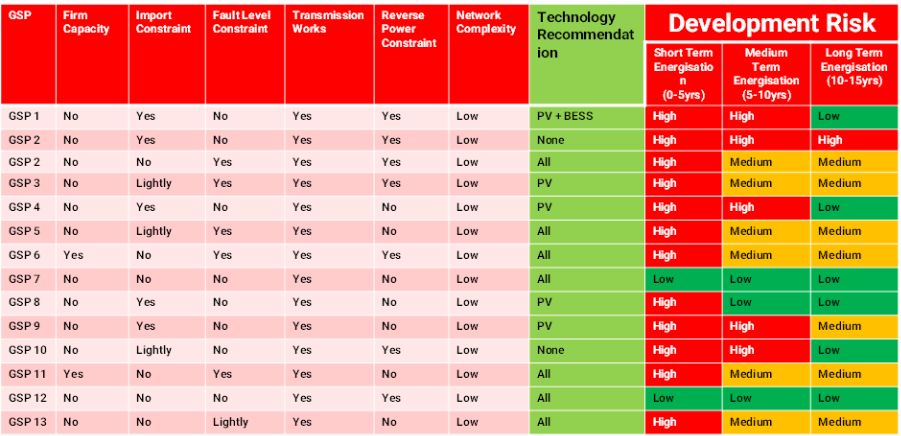
(Table illustrates the summary results of a capacity screening exercise covering 13 GSP areas considering risks over the short-to-long term)
SGS’s time step approach uses publicly-available data to perform eligibility criteria to model Gate 1 and Gate 2 progression, thus providing an estimate of network headroom for DER developers who wish to take advantage of Connection Reform queue attrition and secure capacity on the network. The time step approach provides a detailed insight into potential curtailment exposure and identifies what available headroom could exist outside the planning envelope.
In 2026 and beyond, the challenge is not just finding theoretical capacity, it is also the uncertainty which committing capital before queue certainly brings. By providing data driven insights into potential network capacity access risk ahead of formal grid application submission, DER developers can reduce their connection risk exposure.
Let’s Discuss
SGS is deeply engaged across the electricity sector, providing analysis and advisory support to stakeholders from developers and investors in renewable energy systems to DSOs and Transmission Owners/Operators. For many years we have supplied software systems for energy asset control and delivered specialist advisory services such as constraint and curtailment modelling. We follow industry changes relating to the connection and management of diverse generation and storage technologies. We are keen to capture those experiences and our knowledge to ensure our services are informative and valuable to other stakeholders participating in the energy system.

Leave a Comment